
Regarding Identity

Saul lost his throne, but he never stopped being a son of Israel. His authority was removed, but his humanity was not erased. His position changed. His identity did not.

This distinction matters more than most believers realize.

When Saul disobeyed the Lord, the kingdom was torn from his hands. Scripture is clear about that. God rejected Saul as king. But nowhere does God say Saul stopped being a person made in His image. Saul was removed from office, not removed from existence. Judgment addressed function, not worth.

We often confuse these two.

In the kingdom of God, position and identity are not the same thing. Position can be given and taken. Identity is received. Saul was anointed for a role. That role could be lost. But his identity as a human being created by God was never up for debate.

This matters because many believers live as though failure strips them of sonship. They read stories like Saul’s and quietly assume, If I disobey, God will reject me too. But that assumption collapses under the finished work of Jesus.

Under the old covenant, kingship was conditional. It depended on obedience, leadership, and representation of God before the people. Saul’s calling was external. His throne was never meant to define his value. It was meant to serve the people. When he failed in that stewardship, the role was removed.

But in Christ, identity is no longer tied to function.

You do not become a child of God by performing well. And you do not stop being a child of God when you fail. Sonship is not a position you hold. It is a relationship you are born into.

This is where many believers get trapped. They lose a ministry role, a season of influence, a sense of usefulness, and they assume they have lost God’s affection. But what was lost was a position, not an identity. God may shift assignments. He may remove responsibilities. He may close doors. None of that touches who you are in Christ.

Saul clung to the throne because he believed the throne defined him. That is the real tragedy of his story. Not that he lost the kingdom, but that he could not separate who he was from what he did. When identity is rooted in position, loss feels like annihilation.

The gospel frees us from that fear.

Jesus did not come to give us a role. He came to give us a name. Children. Sons. Heirs. And that identity does not fluctuate with obedience or failure. It is anchored in His obedience, not ours.

When you understand this, you stop striving to protect titles and start resting in belonging. You stop reading Scripture through fear and start reading it through love. You realize that God correcting a path is not God rejecting a person.

Saul lost a crown.

Believers have received a Father.

And nothing you lose in this life can take that away.

Brian Romero

Christ’s Freedom

One of the loudest lies in performance based Christianity is the idea that freedom is the reward for commitment. Many believers think healing comes after discipleship, restoration after obedience, and identity after discipline. The Gerasene demoniac shatters that belief in one encounter. Jesus frees this man before he follows Him, before he obeys Him, and before he even speaks coherently. Grace does not wait for readiness. Grace creates it.

Mark tells us that Jesus crosses the Sea of Galilee into the region of the Gerasenes (Mark 5:1, ESV). This is Gentile territory. Unclean land by Jewish standards. Immediately, a man with an unclean spirit meets Him coming out of the tombs (Mark 5:2, ESV). This man is isolated, violent, naked, and uncontrollable. He lives among the dead. Chains cannot restrain him. Night and day he cries out and cuts himself with stones (Mark 5:3–5, ESV). This is not a seeker. This is not a disciple in process. This is a man completely overtaken.

The man runs toward Jesus and falls down before Him, but notice who speaks next. It is not the man. It is the demons. “What have you to do with me, Jesus, Son of the Most High God?” (Mark 5:7, ESV). Here is the revelation. The demons recognize Jesus’ lordship before the man is free. Authority does not wait for transformation. Authority initiates it.

Jesus does not ask the man to change. He does not ask him to repent. He does not ask him to believe. Jesus commands the unclean spirit to come out of the man (Mark 5:8, ESV). Grace confronts bondage directly. The demons beg Jesus not to torment them and ask permission to enter a herd of pigs (Mark 5:10–12, ESV). Even darkness must ask permission. That is lordship.

After the demons leave, the man is found sitting, clothed, and in his right mind (Mark 5:15, ESV). This happens before instruction. Before teaching. Before repentance language. Before follow up. Freedom comes first. Identity follows. This is the opposite of religious order. Religion says behave, then belong. Jesus restores belonging and behavior follows.

Then something stunning happens. The man begs Jesus that he might be with Him (Mark 5:18, ESV). This is the first time the man speaks for himself. Freedom gives him desire. Grace awakens devotion. But Jesus does something unexpected. He does not allow him to follow physically. Instead, He sends him home. “Go home to your friends and tell them how much the Lord has done for you, and how he has had mercy on you” (Mark 5:19, ESV).

Here is the fire revelation. Jesus commissions a man who has no theological training, no moral resume, and no discipleship track record. His only qualification is mercy. And Mark tells us that the man goes and proclaims what Jesus had done, and everyone marvels (Mark 5:20, ESV). He becomes a witness not because he followed Jesus well, but because Jesus freed him fully.

This encounter screams the finished work of Christ. At the cross, Jesus did not partially free humanity and then wait to see who behaved well enough to follow. Scripture tells us that Jesus came to destroy the works of the devil (1 John 3:8, ESV). That destruction was decisive, not conditional. Deliverance is not something we earn through obedience. It is something we walk out because it already happened.

The man did not follow Jesus to get free.
The man got free and then wanted to follow.

That is how Jesus is revealed as Lord.

Flexible in Spirit!

God is seeking out His pliable ones, vessels that hold the New Wine! There is a new currency being released from heaven and it is beginning to rest upon ‘first fruit’ manifestations and offerings. New Wine skins that are flexible and well capable to hold the efficacy dimensions of God. First fruits yield a pleasing aroma unto Him and in the infancy of becoming, it allows for being fashioned and formed in the Potters Hands.

‘Flex in Spirit’ is an expression that refers to being flexible in faith and putting ones talents to use for God. Now there is a new currency about to overshadow and bring about a wealth transfer as never seen before. This is a spiritual flex, and the Arm of The Lord has extended in Righteousness!

What does it mean to be Flexible in Spirit? It means to bend without breaking! It is the ability to adapt or change according to any situation and circumstance. This is a season where many are being transplanted, transported, relocated as the tent pegs are stretching out. It’s the New Wine Skin that shall flex in order to become adaptable, versatile and even resilient, this is for the ability to adjust to new situations and challenges. All of this God is supernatural extending an agility to the Body of Christ that She may react quickly and easily under the instruction of His Voice.

The New Currency of Greater Glory outpouring has begun, birthed as first fruit signs and wonders, but a mighty deluge is about to to be released and it will take being Flexible in Spirit to run with this Wave of God. Faith is heavens currency but a new currency of the dimensional Spirit of Wisdom is coming that shall have manifold divine ramifications in every sphere pertaining to His Beloved. And it is boundless!

Manifold divine ramifications? To ‘ramify’ means to split into branches and extensions. To cause to branch. It is an…offshoot of the Latin word for Branch! I believe this to be the mighty flex of The Tree of LIfe, the Lord Jesus!

I hear the Lord say, “Get Oily!” Constantly being filled by Holy Spirit. Remain pliable within His Hand in order to be constantly conformed to His perfect will, a place where new wine flows easily. Remain flexible for easy adaptation. Branches shall extend to the right and the left, new shoots shall spring forth…. A pleasing aroma is arising!

Mark 2:22

“And no one puts new wine into old wineskins. For the wine would burst the wineskins, and the wine and the skins would both be lost”

Isaiah 54:2-3

Enlarge the place of your tent, stretch your tent curtains wide, do not hold back; lengthen your cords, strengthen your stakes. For you will spread out to the right and to the left; your descendants will dispossess nations and settle in their desolate cities.

Philippians 4:12-13

I know how to be brought low, and I know how to abound. In any and every circumstance, I have learned the secret of facing plenty and hunger, abundance and need. I can do all things through him who strengthens me.

Denise Sylvia Bruning

A Lesson from The Tower of Babel

The Tower of Babel is often told as a cautionary tale against ambition. Don’t aim too high. Don’t try to make a name for yourself. Don’t build or God will come down and shut it all down. Many believers subconsciously learn that unity is dangerous, success is suspicious, and visibility invites judgment. But that interpretation misses the heart of the story and quietly contradicts the gospel.

The problem at Babel was not building. It was motivation. Scripture says the people said, “Come, let us build ourselves a city and a tower with its top in the heavens, and let us make a name for ourselves, lest we be dispersed.” That sentence reveals everything. The tower was not an act of worship. It was an act of self preservation. They were not trying to reach God. They were trying to secure identity apart from Him. Fear of scattering drove them to manufacture unity. They were united, but not surrendered.

God’s response is often misunderstood as jealousy or insecurity. But God does not come down to punish ambition. He comes down to interrupt a system that would eventually crush them. A single language combined with fear driven unity would have produced domination, control, and exclusion. Babel was the birth of performance based identity. If we build high enough, we matter. If we stay together tightly enough, we are safe. God’s intervention was mercy, not wrath. He disrupted their communication to save humanity from building a world without dependence on Him.

Many people misread this story and assume God opposes unity. The New Testament proves the opposite. At Pentecost, God does not scatter language. He redeems it. Tongues are not confused. They are understood. The same God who divided language at Babel restores communication in Christ. The difference is stunning. Babel was humans reaching up to make a name. Pentecost was God coming down to give a name. One was driven by fear. The other by grace.

Here is the revelation that shifts everything. Babel says, “Let us make a name for ourselves.” Philippians says God gave Jesus “the name above every name.” At Babel, humanity tried to ascend. In Christ, God descended. The gospel does not crush ambition. It relocates it. We no longer strive to be seen. We are sent because we are already known. Unity in Christ is not built on fear of separation. It is built on secure sonship.

This story brings peace because it removes the anxiety that God is against growth, influence, or collaboration. God is not threatened by success. He is protective against identity built without Him. You do not need to shrink to stay safe with God. You are free to build when your name is no longer on the line. In Christ, your value is settled. You are not trying to reach heaven. Heaven has already reached you.

The practical application is liberating. Examine what is driving your building. Is it fear of being insignificant or joy rooted in calling? Are you striving to secure identity or expressing what you already have? Today, you can build from rest instead of insecurity. God is not confusing your progress. He is clarifying your foundation. Build boldly. Build humbly. Build knowing your name is already written in heaven.

Brian Romero

Draw Near

Many believers live carefully with God. They love Him, but they are cautious. They pray with restraint. They worship with filters. They approach Scripture like they’re being graded. Underneath their devotion is a subtle anxiety. Am I praying the right way? Am I hearing Him correctly? Am I sincere enough? This insecurity doesn’t come from rebellion. It comes from wanting to honor God while quietly fearing disapproval.

The Greek word parrēsia is often translated as “boldness” or “confidence,” but those words don’t capture its force. Parrēsia literally means free and open speech in the presence of authority. It describes the right to speak without fear of punishment, rejection, or consequence. In ancient culture, only those with secure standing were allowed parrēsia before a king. Scripture uses this word to describe how believers are meant to relate to God.

Hebrews 4:16 says, “Let us then with confidence draw near to the throne of grace” (ESV). The word confidence there is parrēsia. This is not emotional bravery. It is relational security. The false belief parrēsia dismantles is the idea that you must approach God correctly in order to be accepted. That belief turns prayer into performance and faith into a fragile transaction. But parrēsia reveals that acceptance is the starting point, not the reward.

When parrēsia is misunderstood, believers self-censor in God’s presence. They hide doubts. They soften honesty. They avoid coming close when they feel messy or unsure. But Scripture says something radical. Because of Jesus, you are invited to come freely, openly, honestly, without rehearsing, without posturing, without fear. God is not offended by your weakness. He is not threatened by your questions. He is not measuring your approach. He is welcoming your presence.

Understanding parrēsia changes how you pray. You stop trying to sound spiritual and start being real. You stop wondering if you’re allowed to ask. You stop fearing that one wrong move will create distance. Confidence stops being something you manufacture and becomes something you receive. Grace stops feeling fragile. And God stops feeling like someone you must approach carefully.

This is why Scripture ties parrēsia to the finished work of Jesus. Hebrews 10:19 says we have parrēsia to enter the holy places by the blood of Jesus. That means your access is not based on spiritual correctness. It is based on Christ’s sacrifice. You are not speaking out of turn when you speak to God. You are speaking from belonging.

You are not insecure in God’s presence.

You are invited there.

And because the work is finished, you are free to speak, ask, and come close without fear.

Brian Romero

What Defiles

When Jesus calls the crowd and says, “Hear me, all of you, and understand” (Mark 7:14, ESV), He is not clarifying a small detail. He is dismantling an entire religious framework. For generations, people believed holiness could be preserved by managing externals. What you touched. What you ate. What you avoided. Jesus says plainly, “There is nothing outside a person that by going into him can defile him” (Mark 7:15, ESV). That sentence alone ends fear based spirituality.

Jesus is not minimizing sin. He is relocating the conversation. Defilement is not caused by exposure. It is revealed by expression. The problem is not what enters the body. The problem is what already lives in the heart.

When the disciples ask for clarification, Jesus goes even further. “Do you not see that whatever goes into a person from outside cannot defile him, since it enters not his heart but his stomach” (Mark 7:18–19, ESV). This is not poetic language. It is surgical clarity. External things never reach the heart. They pass through the body and exit. They were never designed to shape identity.

Then Jesus says the words that unsettle everyone. “What comes out of a person is what defiles him” (Mark 7:20, ESV). The list that follows is sobering. Evil thoughts. Sexual immorality. Greed. Envy. Pride. But here is the revelation most people miss. Jesus is not saying these things suddenly appear because of bad behavior. He is saying they originate from within fallen humanity. Behavior is the symptom. Not the source.

This is where the finished work of Jesus Christ brings peace instead of despair. If the heart is the problem, then behavior modification will never be the solution. You cannot clean the stream by disciplining the water. You must change the source.

Jesus is not condemning the crowd. He is preparing them for the gospel. He is exposing that the human heart, apart from God, cannot be fixed from the outside. It must be made new from the inside. This is why the new covenant promise matters so deeply. “I will give you a new heart, and a new spirit I will put within you” (Ezekiel 36:26, ESV).

Religion says guard yourself from contamination. Jesus says receive a transformation. Under the law, holiness was protected by separation. Under grace, holiness is produced by regeneration. The heart of stone is not trained. It is replaced.

This teaching also brings rest to believers who are constantly afraid of being defiled by the world. Jesus removes that fear entirely. You are not corrupted by proximity. You are not stained by exposure. You are not undone by circumstances. If you are in Christ, your heart has been made new. Sin does not flow from your identity. It contradicts it.

Yes, believers can still act out of the flesh. But that is not because the heart is evil. It is because the mind has not yet fully aligned with the new heart it has been given. This is why transformation in the New Testament flows from renewal, not restraint.

The application is freeing. Stop managing externals to feel clean. Stop fearing contamination. Stop confusing temptation with identity. Instead, live from the truth of what God has already done within you. A new heart produces new fruit over time.

Brian Romero

Gracious Love

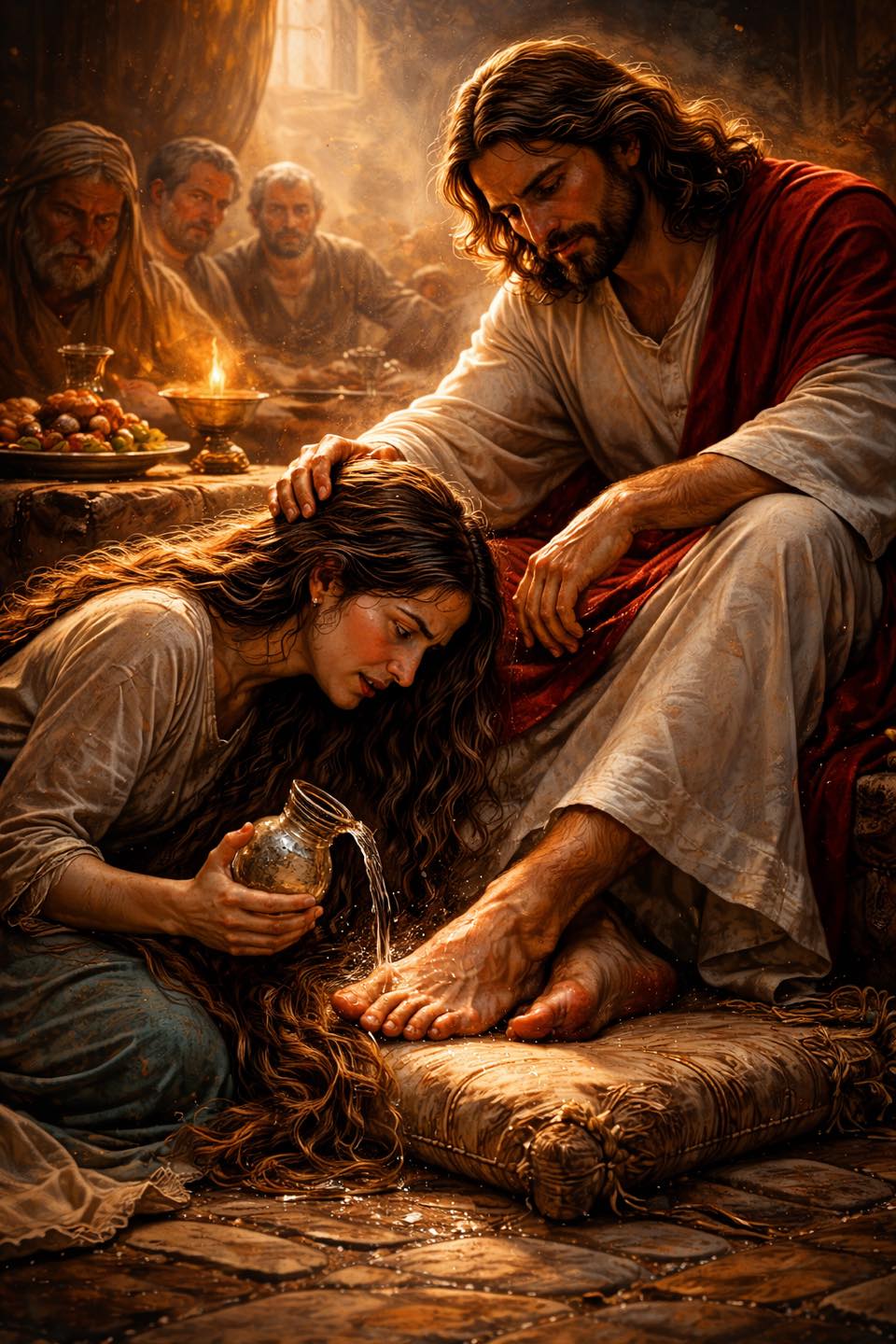
Few passages have been misread more than the story of the woman who anointed Jesus’ feet. This account has often been used to suggest that deep love earns forgiveness. But Jesus teaches the exact opposite. Love does not purchase grace. Love erupts when grace is believed. The moment we reverse that order, we turn worship into performance and affection into currency. Jesus dismantles that thinking completely in this encounter.

Luke tells us that Jesus was invited to the house of a Pharisee named Simon (Luke 7:36, ESV). This is a religious setting, controlled, measured, and observant. While Jesus reclines at the table, a woman known in the city as a sinner enters the room (Luke 7:37, ESV). She brings an alabaster flask of ointment, stands behind Jesus, and begins to weep. Her tears fall on His feet. She wipes them with her hair, kisses His feet, and anoints them with oil (Luke 7:38, ESV). This is extravagant, vulnerable, and socially dangerous. Yet Jesus allows it.

Simon immediately interprets the moment through a performance mindset. He reasons within himself that if Jesus were truly a prophet, He would know what kind of woman this is and would not allow her to touch Him (Luke 7:39, ESV). Simon believes holiness withdraws from sinners. Jesus reveals that holiness moves toward them. Grace is not contaminated by sin. Sin is undone by grace.

Jesus answers Simon’s thoughts with a parable. He speaks of two debtors, one who owed much and one who owed little. When neither could pay, the lender canceled both debts (Luke 7:41–42, ESV). Then Jesus asks which debtor will love more. Simon answers correctly, “The one, I suppose, for whom he canceled the larger debt” (Luke 7:43, ESV). This is the key. Love does not cancel debt. Canceled debt produces love.

Jesus then turns toward the woman and contrasts her actions with Simon’s lack of hospitality. Simon did not give water for Jesus’ feet. She washed them with tears. Simon did not greet Jesus with a kiss. She has not stopped kissing His feet. Simon did not anoint His head with oil. She anointed His feet with ointment (Luke 7:44–46, ESV). The difference is not effort. It is revelation. One believes he is owed grace. The other knows she has received it.

Then Jesus makes the statement that is often misunderstood. “Her sins, which are many, are forgiven, for she loved much” (Luke 7:47, ESV). But Jesus immediately clarifies the meaning. “But he who is forgiven little, loves little.” The word for in this verse points to result, not cause. Her love is not the reason she is forgiven. Her love is the evidence that forgiveness has already taken root in her heart.

Jesus then speaks directly to the woman. “Your sins are forgiven” (Luke 7:48, ESV). This is not a response to her worship. It is a declaration of grace. The other guests are unsettled and ask, “Who is this, who even forgives sins?” (Luke 7:49, ESV). That is the point. Lordship is revealed through mercy, not moral control.

Jesus finishes with words that anchor the entire encounter in grace. “Your faith has saved you. Go in peace” (Luke 7:50, ESV). Her faith was not in her tears. It was not in her devotion. It was in Jesus’ willingness to forgive. Peace follows grace, not striving.

This moment points directly to the finished work of Christ. At the cross, forgiveness was not made conditional on love, sorrow, or performance. Scripture tells us that Jesus offered one sacrifice for sins for all time (Hebrews 10:12, ESV). Forgiveness is complete. Worship now flows freely. We do not love God to be forgiven. We love God because forgiveness has already been secured.

She did not worship her way into grace.

She worshiped because grace had already found her.

That is how Jesus is revealed as Lord.

Brian Romero

Oil and Lamp

When Jesus tells the parable of the ten virgins, He is not trying to frighten sincere believers. He is exposing a misunderstanding about readiness. “Then the kingdom of heaven will be like ten virgins who took their lamps and went to meet the bridegroom” (Matthew 25:1, ESV). All ten are invited. All ten are waiting. All ten have lamps. From the outside, they look identical. This parable is not about obvious rebellion versus obedience. It is about inward reality.

Five are called wise. Five are called foolish. The difference is not morality. It is oil. The foolish took lamps but no oil. The wise took oil in jars with their lamps. Oil in Scripture consistently points to life, intimacy, and the Spirit of God. Lamps represent outward profession. Oil represents inward supply. You can look prepared and still lack what sustains you.

Then something deeply important happens. “As the bridegroom was delayed, they all became drowsy and slept” (Matthew 25:5, ESV). Notice this carefully. All of them slept. Sleeping is not the issue. Delay is not the problem. Jesus is not condemning rest. He is showing that time exposes what is real. When the wait is long, performance eventually runs out. Only supply remains.

At midnight the cry goes out. Midnight is the hour of surprise, not scheduling. “Here is the bridegroom! Come out to meet him” (Matthew 25:6, ESV). Everyone wakes. Everyone trims their lamps. But suddenly the difference is revealed. The foolish lamps are going out. Not because they never burned, but because they were never sustained. Borrowed light always fades.

The foolish ask for oil. The answer sounds harsh, but it is honest. Oil cannot be shared. Relationship cannot be transferred. Intimacy cannot be borrowed. You cannot live on someone else’s revelation, someone else’s faith, or someone else’s history with God. Each person must receive oil for themselves.

Here is the revelation many miss. The foolish are not rejected for being immoral. They are rejected because they are unknown. “Truly, I say to you, I do not know you” (Matthew 25:12, ESV). This is not about loss of salvation through failure. It is about never having lived from relationship in the first place. Knowing in Scripture is relational language, not performance language.

Through the finished work of Jesus Christ, this parable becomes clearer and gentler. Oil is not something you earn by striving. It is something you receive by abiding. The Spirit is not given to those who work harder, but to those who believe. The wise virgins are not anxious achievers. They are those who have learned to live from supply rather than appearance.

The door is shut not because God is cruel, but because arrival has taken place. Preparation ends when fulfillment begins. The tragedy of the foolish virgins is not that they were late. It is that they lived on the outside of intimacy the entire time.

The application is not try harder to stay awake. It is receive oil now. Stop substituting activity for intimacy. Stop confusing outward readiness with inward life. The bridegroom is not looking for perfect lamps. He is looking for hearts filled with oil.

Brian Romero

Wine and Wineskins

When Jesus speaks about a new patch on an old garment and new wine in old wineskins, He is not teaching improvement. He is announcing replacement. This parable is often softened into a lesson about balance or wisdom, but Jesus is doing something far more radical. He is declaring that the old system cannot be repaired, reinforced, or upgraded. It must be left behind entirely.

Jesus says, “No one puts a piece of unshrunk cloth on an old garment, for the patch tears away from the garment, and a worse tear is made” (Matthew 9:16, ESV). The problem is not the cloth. The new cloth is good. The problem is the garment. The old garment has already been stretched, weathered, and shaped by time. When the new cloth begins to shrink, it exposes what was already fragile. Grace does not cause the tear. Grace reveals it.

Here is the revelation most people miss. Jesus is not warning people not to mix traditions. He is revealing that grace will always disrupt performance. When you introduce the finished work of Christ into a system built on effort, striving, and self righteousness, tension is inevitable. Not because grace is harsh, but because the old system cannot flex. It cannot stretch. It cannot survive freedom.

Then Jesus deepens the image. “Neither is new wine put into old wineskins. If it is, the skins burst and the wine is spilled and the skins are destroyed” (Matthew 9:17, ESV). Wine in Scripture often represents life, joy, and the work of the Spirit. New wine is alive. It expands. It ferments. Old wineskins were stiff, brittle, and already stretched to capacity. They were designed for a previous filling, not a living one.

This is not a message about behavior modification. It is a message about identity. The old wineskin represents the old way of relating to God through law, self effort, and religious obligation. The new wine represents the life of Christ Himself poured into the believer through the finished work of the cross. You cannot contain resurrection life inside a system built for performance.

Here is where peace comes in. Many believers feel like they are failing because they cannot sustain religious pressure. They try to patch grace onto law. They try to pour joy into obligation. They wonder why things keep tearing or bursting. Jesus is saying gently, the problem is not you. The problem is the container. You were never meant to carry the life of Christ inside a system of self maintenance.

Jesus concludes, “But new wine is put into fresh wineskins, and so both are preserved” (Matthew 9:17, ESV). Fresh wineskins are soft. They are flexible. They expand with what they carry. This is what happens when righteousness is received as a gift, not achieved by effort. Grace creates capacity. Rest creates room. Assurance allows the life of Christ to grow without fear of rupture.

The finished work of Jesus did not come to help the old you behave better. It came to create a new you altogether. “If anyone is in Christ, he is a new creation” (2 Corinthians 5:17, ESV). New creation life requires a new container. Not a patched identity. Not a reinforced mindset. A completely new way of being.

The application is freeing and clear. Stop trying to fit grace into old expectations. Stop pouring the joy of Christ into fear driven Christianity. Let go of the need to preserve what Jesus came to fulfill and replace. Receive the new wineskin God has already given you in Christ. As you do, the life of Jesus will not strain you. It will sustain you.

New wine belongs in new wineskins. And you are already made new.

Brian Romero

Prophetic Symbolism of Aaron’s Rod

Aaron’s rod that budded (Numbers 17) is one of the most powerful prophetic signs in Scripture. It reveals God’s authority, divine election, resurrection life, and the legitimacy of spiritual leadership.

1. Dead Wood That Produced Life – Resurrection Power

Aaron’s rod was a dead stick—cut off from roots, soil, and water. Yet overnight it:

• Budded

• Blossomed

• Produced ripe almonds

Prophetic meaning:

• God brings life out of death

• Divine life does not depend on natural conditions

• Resurrection power overrides barrenness

Prophetic truth:

What God chooses may look dead, overlooked, or finished—but His life can cause sudden fruitfulness.

“God… quickeneth the dead.” (Romans 4:17)

2. Divine Selection and Legitimate Authority

The budding rod was God’s answer to rebellion and competition among the tribes. Each leader brought a rod, but only Aaron’s budded.

Prophetic meaning:

• God chooses whom He wills

• Calling is not self-appointed

• Authority comes from God, not popularity

Prophetic truth:

God confirms His chosen servants by fruit, not arguments.

“The gifts and calling of God are without repentance.” (Romans 11:29)

3. Almonds – Watchfulness and Divine Timing

The almond tree is the first tree to awaken in spring. In Hebrew thought, it symbolizes watchfulness and readiness.

Prophetic meaning:

• God is watching over His word to perform it

• God’s timing is precise and intentional

• Awakening precedes harvest

“I will hasten (watch over) My word to perform it.” (Jeremiah 1:11–12)

Prophetic truth:

Aaron’s rod declares that God is alert, active, and intentional about fulfilling His promises.

4. Stored in the Ark – A Testimony Forever

Aaron’s rod was placed inside the Ark of the Covenant as a perpetual sign.

Prophetic meaning:

• God preserves what He establishes

• True authority stands in His presence

• God silences rebellion with evidence, not noise

Prophetic truth:

What God authenticates does not need defending—it stands as a testimony before Him.

5. Priestly Authority and Intercession

Aaron’s rod represented the priesthood, not kingship or prophecy.

Prophetic meaning:

• God affirms intercessory leadership

• Life flows from those who stand before God

• Ministry that brings life is validated by heaven

Prophetic truth:

Those who minister in God’s presence will carry life-giving authority.

6. Christological Fulfillment

Aaron’s rod ultimately points to Jesus Christ:

• Cut off (death)

• Raised to life (resurrection)

• Bearing fruit (eternal life for many)

Prophetic truth:

Jesus is the ultimate Rod that budded—life out of death, authority affirmed by resurrection.

Prophetic Declarations

What was dead in my life will live again.

God is validating my calling with fruit.

I walk in divine authority, not human approval.

Life is springing forth suddenly.

God’s choice over my life will be evident.

Key Themes Summarized

• Resurrection life

• Divine election

• Spiritual authority

• Fruitfulness

• Watchfulness

• God-set leadership

Apostle John Eckhardt